Khóa học
IELTS Online
IELTS Online
Giảm đến 18%
Đăng ký ngay
Mục lục [Ẩn]
Bạn đang ôn luyện IELTS Reading và muốn hiểu sâu hơn bài “Views of Intelligence Across Cultures” – một chủ đề học thuật khó, đầy thuật ngữ và dễ gây nhầm lẫn? Đây chính là nội dung bạn không thể bỏ qua. Trong bài viết này, Langmaster sẽ giúp bạn nắm trọn ý chính, từ vựng trọng tâm và các dạng câu hỏi thường gặp trong phần đọc này.
| Bạn đang ở band IELTS bao nhiêu? Làm bài test miễn phí và nhận ngay lộ trình học cá nhân hóa. 👉 Đăng ký test IELTS miễn phí ngay |
PASSAGE 1
Views of Intelligence Across Cultures
A. In recent years, researchers have found that people in non-Western cultures often have ideas about intelligence that are considerably different from those that have shaped Western intelligence tests. This cultural bias may therefore work against certain groups of people. Researchers in cultural differences in intelligence, however, face a major dilemma, namely: how can the need to compare people according to a standard measure be balanced with the need to assess them in the light of their own values and concepts?
B. For example, Richard Nesbitt of the University of Michigan concludes that East Asian and Western cultures have developed cognitive styles that differ in fundamental ways, including how intelligence is understood. People in Western cultures tend to view intelligence as a means for individuals to devise categories and engage in rational debate, whereas Eastern cultures see it as a way for members of a community to recognize contradiction and complexity and to play their social roles successfully. This view is backed up by Sternberg and Shih-Ying, from the University of Taiwan, whose research shows that Chinese conceptions of intelligence emphasize understanding and relating to others, and knowing when to show or not show one’s intelligence.
C. The distinction between East Asia and the West is just one of many distinctions that separate different ways of thinking about intelligence. Robert Serpell spent a number of years studying concepts of intelligence in rural African communities. He found that people in many African communities, especially in those where Western-style schooling is still uncommon, tend to blur the distinction between intelligence and social competence. In rural Zambia, for instance, the concept of nzelu includes both cleverness and responsibility. Likewise, among the Luo people in rural Kenya, it has been found that ideas about intelligence consist of four broad concepts. These are named paro or practical thinking, luoro, which includes social qualities like respect and responsibility, winjo or comprehension and rieko. Only the fourth corresponds more or less to the Western idea of intelligence.
D. In another study in the same community, Sternberg and Grogorenko have found that children who score highly on a test of knowledge about medicinal herbs, a test of practical intelligence. This suggests that practical and academic intelligence can develop independently of each other, and the values of a culture may shape the direction in which a child’s intelligence develops. It also tends to support a number of other studies which suggest that people who are unable to solve complex problems in the abstract can often solve them when they are presented in a familiar context. Ashley Maynard, for instance, now professor of psychology at the University of Hawaii, conducted studies of cognitive development among children in a Mayan village in Mexico using toy looms, spools of thread an other materials drawn from the local environment. The research suggested that the children’s development could be validly compared to the progression described by Western theories of development, but only by using materials and experimental designs based on their own culture.
E. The original hope of many cognitive psychologists was that a test could be developed that was absent of cultural bias. However, there seems to be an increasing weight of evidence to suggest that this is unlikely. Raven’s Progressive Matrices, for example, were originally advertised as ‘culture free’ but are now recognized as culturally loaded. Such non-verbal intelligence tests are based on cultural constructs which may not appear in a particular culture. It is doubtful whether cultural comparisons of concepts of intelligence will ever enable us to move towards creating a test which encompasses all aspects of intelligence as understood by all cultures. It seems even less likely that such a test could be totally free of cultural imbalance somewhere. The solution to the dilemma seems to lie more in accepting that cultural neutrality is unattainable and that administering any valid intelligence test requires a deep familiarity with the relevant culture’s values and practices
Questions 1-4
Reading Passage has five sections, A-E
Choose the correct heading for sections B-E from the list of headings below
List of Headings
1. Section B
2. Section C
3. Section D
4. Section E
Questions 5-9
Look at the following findings (Questions 5-9) and the list of researchers below
Match each finding with the correct researcher, A-E
List of findings
5. There is a clear relationship between intelligence and relationships with others in Chinese culture.
6. The difference between intelligence and social competence is not distinct in many African communities.
7. Children frequently scoring well in practical tests score less well in academic tests.
8. In experiments to measure cognitive development, there is a link between the materials used and the test results.
9. The way cognition is viewed in East Asian cultures differs fundamentally from those in Western cultures.
List of researchers
Question 10-12
The list below gives statements about non-verbal intelligence tests.
Which THREE statements are mentioned by the writer of the passages?
A. Raven’s Progressive Matrices are widely considered to be culturally free.
B. Cultural comparisons will allow the development of culturally neutral tests.
C. The development of culturally neutral tests is unlikely.
D. Raven’s Progressive Matrices are culturally specific.
E. The creation of culturally-free tests is sometimes possible.
F. Many cognitive psychologists originally hoped tests could be developed free of cultural bias.
Question 13
Choose the correct letter, A, B, C or D
Which of the following is the main argument of the article?
A. Intelligence tests should include tests of social skills and responsibility.
B. Test takers from any culture can learn the cognitive style required by Western intelligence tests.
C. Intelligence tests cannot be free of cultural bias.
D. More research is needed to develop an intelligence test which is valid for all cultures
>> Xem thêm: Sentence completion IELTS READING: Cách làm & bài tập
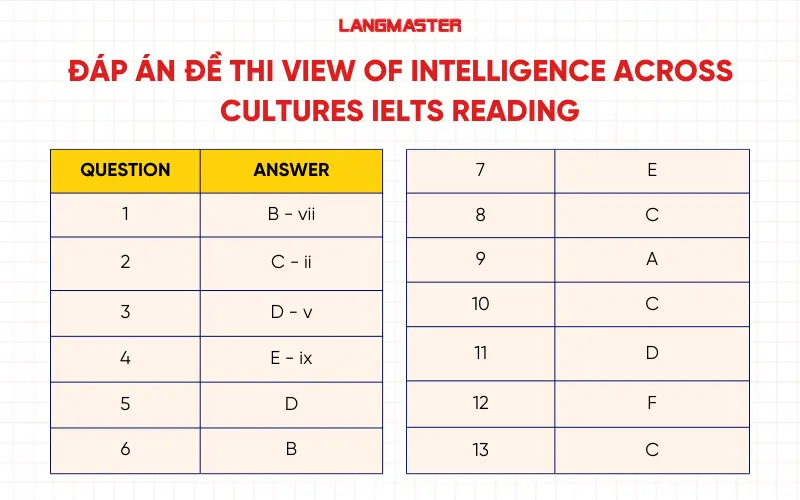
1. Đáp án: Section B → Heading vii
Giải thích: Đoạn B nói rõ rằng:
Đoạn B so sánh trực tiếp cách hiểu trí thông minh giữa phương Đông và phương Tây → hoàn toàn trùng với heading vii.
2. Đáp án: Section C → Heading ii
Đoạn C trình bày quan niệm về trí thông minh của nhiều cộng đồng người châu Phi, không phải nghiên cứu cụ thể về đời sống cộng đồng → phù hợp heading ii, không phải heading i.
3. Đáp án: Section D → Heading v
Đoạn D chứng minh rằng để đánh giá trí thông minh chính xác, cần dùng nội dung phù hợp với văn hóa của trẻ → trùng với heading v.
4. Đáp án: Section E → Heading ix.
Đoạn E nêu rõ việc tạo ra bài test hoàn toàn không thiên vị văn hóa là không thể, khẳng định sự bất khả thi → đúng với heading ix.
5. Đáp án: D
Thông tin đoạn B: “…research shows that Chinese conceptions of intelligence emphasize understanding and relating to others, and knowing when to show or not show one’s intelligence.”
=> Cặp Sternberg & Shih-Ying nghiên cứu khái niệm trí thông minh của người Trung Quốc, nhấn mạnh mối liên hệ với người khác → đúng với mô tả.
6. Đáp án: B
Thông tin đoạn C: “People in many African communities… tend to blur the distinction between intelligence and social competence.”
=> Robert Serpell nghiên cứu tại các cộng đồng nông thôn châu Phi, và phát hiện trí thông minh gắn liền với trách nhiệm, sự tôn trọng, không tách biệt rõ ràng với năng lực xã hội.
7. Đáp án: E
Thông tin đoạn D: “Children who score highly on a test of knowledge about medicinal herbs … practical intelligence can develop independently of academic intelligence.”
=> Sternberg và Grigorenko phát hiện ra trẻ giỏi bài test thực tiễn nhưng không nhất thiết giỏi bài test học thuật, chứng minh sự phát triển độc lập.
8. Đáp án: C
Thông tin đoạn D: Maynard “conducted studies … using toy looms, spools of thread … drawn from the local environment.”
“…children’s development could only be validly compared… when using materials based on their own culture.”
=> Maynard cho thấy kết quả test phụ thuộc vào việc dùng đồ vật quen thuộc với trẻ.
9. Đáp án: A
Thông tin đoạn B: Nesbitt concludes that East Asian and Western cultures have developed cognitive styles that differ in fundamental ways.
=> Nesbitt trực tiếp so sánh nhận thức và trí tuệ giữa phương Tây và Đông Á, trùng khớp mô tả.
10 - 12. Đáp án: C - D - F
Giải thích:
A. Bài nói rằng Raven's được quảng cáo là culture-free, không phải “widely considered”. -> Không phải là quan điểm chung của giới chuyên môn → Không chọn.
B. Ngược lại bài viết khẳng định điều này không khả thi.
E. Bài không nói "sometimes possible" → trái với lập luận chính.
13. Đáp án: C
Giải thích:
A. Bài chỉ mô tả cách một số văn hóa coi trọng trách nhiệm, không hề kêu gọi đưa chúng vào bài test.
B. Bài nhấn mạnh sự khác biệt nhận thức.
D. Bài nói điều này không thể thực hiện, không phải cần nghiên cứu thêm để làm được.
| Học mãi mà IELTS không lên band? Học thử IELTS miễn phí cùng giáo viên 7.5+, chấm chữa lỗi sai ngay lập tức. 👉 Đăng ký học thử miễn phí ngay |
>> Xem thêm:
Để hiểu sâu hơn nội dung bài đọc Views of Intelligence Across Cultures và nắm chắc các ý chính, người học cần làm chủ hệ thống từ vựng học thuật xuất hiện trong bài. Phần dưới đây tổng hợp những từ vựng quan trọng nhất, kèm theo nghĩa và cách dùng, giúp bạn ghi nhớ dễ dàng và áp dụng hiệu quả trong bài thi IELTS Reading.
>> Xem thêm: Giải đề IELTS Reading: Meet the Hedgehog (FULL ANSWERS)
Tổng kết lại, chủ đề “Views of Intelligence Across Cultures” đã mang đến cho bạn một cái nhìn toàn diện về sự khác biệt trong cách các nền văn hóa định nghĩa và đánh giá trí thông minh. Thông qua việc phân tích ý chính, nhận diện các quan điểm học thuật, hiểu từ vựng trọng tâm và luyện tập các dạng câu hỏi thường gặp trong IELTS Reading, bạn đã nắm được cách tiếp cận bài đọc học thuật một cách hiệu quả hơn. Đặc biệt, việc so sánh tư duy Đông – Tây, vai trò của bối cảnh văn hóa và tính phi trung lập của các bài kiểm tra trí tuệ giúp bạn rèn luyện kỹ năng suy luận – một trong những kỹ năng then chốt để đạt điểm cao trong Reading.
Tuy nhiên, để đạt mức band điểm như mong muốn bạn cần một lộ trình học rõ ràng, sự sửa lỗi chính xác, và người hướng dẫn đủ kinh nghiệm để chỉ ra điểm yếu của bạn. Đây là điều mà tự học rất khó đáp ứng một cách đầy đủ.
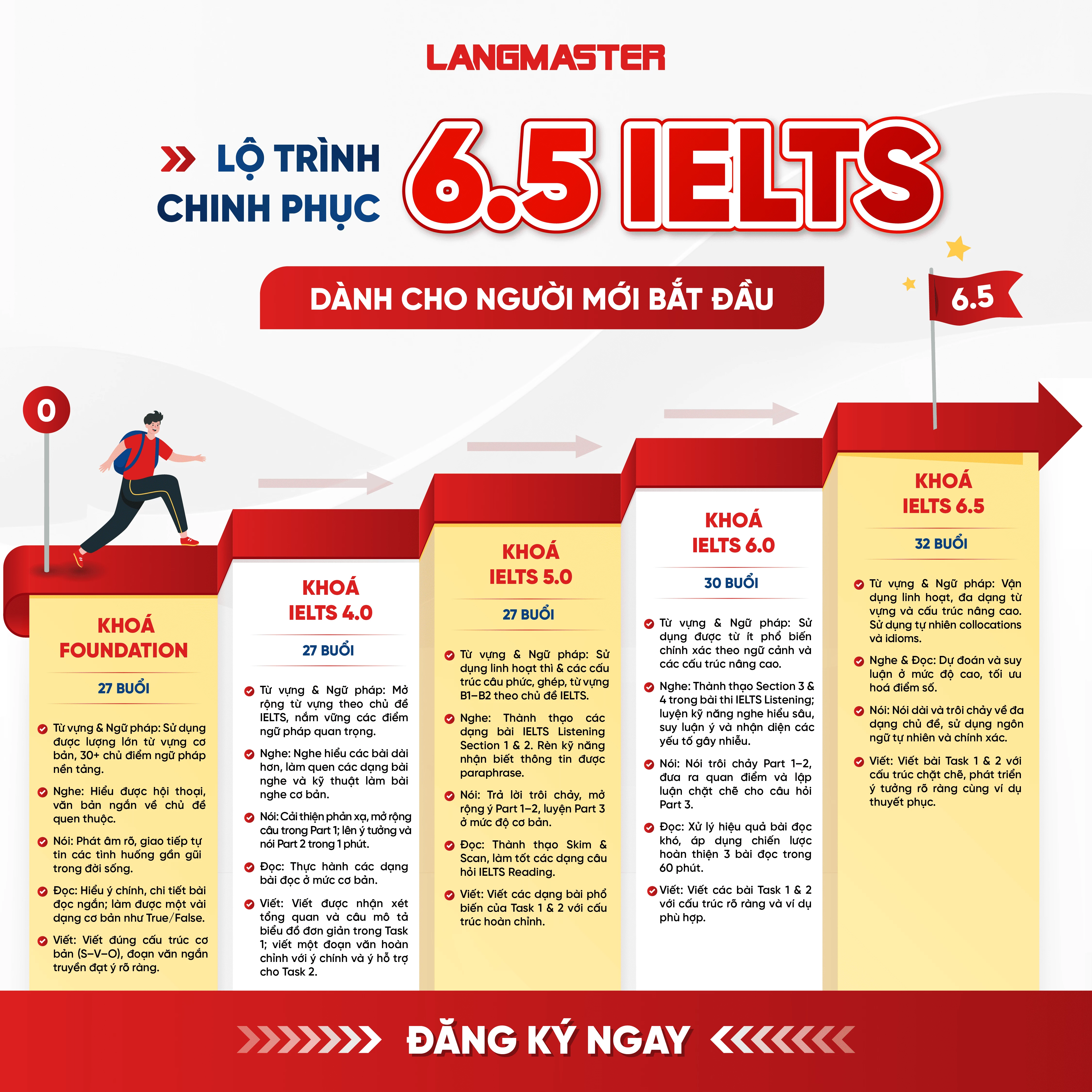
Đó chính là lý do Langmaster trở thành lựa chọn hàng đầu cho những ai đang nghiêm túc chinh phục IELTS. Với hơn 16 năm kinh nghiệm trong đào tạo tiếng Anh học thuật, Langmaster mang đến:
Trước khi bắt đầu hành trình học nghiêm túc, bạn có thể đăng ký buổi học thử IELTS online miễn phí tại Langmaster. Đây là cơ hội để bạn kiểm tra trình độ, được tư vấn lộ trình phù hợp và trải nghiệm trực tiếp phương pháp giảng dạy hiệu quả đang giúp hàng nghìn học viên tăng điểm thật mỗi năm.
Hãy đăng ký ngay hôm nay để bắt đầu chinh phục IELTS Reading cùng Langmaster — nơi bạn không chỉ học để thi, mà còn xây dựng nền tảng tiếng Anh học thuật vững chắc để bứt phá trong học tập, công việc và tương lai.
Các dạng bài phổ biến và tiêu chí chấm điểm IELTS Reading chi tiết nhất: Multiple Choice, Matching Information, Matching Headings,... và hướng dẫn chiến lược làm bài hiệu quả
Những sai lầm khi luyện IELTS Reading bao gồm: dịch từng từ, đọc hết cả bài, không đọc câu hỏi trước, không quản lý thời gian, không nắm vững kỹ năng paraphrase, viết sai chính tả
![Giải đề IELTS Reading: A brief history of humans and food [full answers]](https://langmaster.edu.vn/storage/images/2025/09/20/a-brief-history-of-humans-and-food-ielts-reading-answers.webp)
Giải đề thi IELTS Reading “A brief history of humans and food” kèm full đề thi thật, câu hỏi, đáp án, giải thích chi tiết, và từ vựng cần lưu ý khi làm bài.
Tổng hợp IELTS Reading tips hay nhất giúp bạn đọc nhanh, nắm ý chính và xử lý thông tin chính xác, tự tin đạt điểm cao trong kỳ thi IELTS.
![Giải đề IELTS Reading: The importance of law [Full answers]](https://langmaster.edu.vn/storage/images/2025/09/22/55.webp)
Giải đề IELTS Reading “The importance of law” kèm đáp án chi tiết, từ vựng quan trọng và bí quyết luyện thi hiệu quả để nâng cao band điểm.


Hơn 16 năm kinh nghiệm, đào tạo thành công 800.000+ học viên
Phương pháp giảng dạy hiện đại, học viên tiến bộ rõ rệt
Lộ trình học chuẩn quốc tế, phù hợp với nhu cầu thực tiễn
Giáo viên đạt chuẩn Quốc tế với chất lượng top đầu thị trường, giàu kinh nghiệm
Học online linh hoạt, cam kết đầu ra bằng văn bản

![Giải đề thi European Heat Wave IELTS Reading [FULL ANSWER]](https://langmaster.edu.vn/storage/uploads/original/2025/11/20/european-heat-wave-ielts-reading-answers.png)
![Giải đề IELTS Reading: Young the future of travel [FULL ANSWERS]](https://langmaster.edu.vn/storage/uploads/original/2025/11/21/youth-the-future-of-travel-ielts-reading-answers.png)